I didn't choose this work. This work chose me.
It started not with people, but with animals. Growing up in Jerusalem, I was the kind of child that animals were drawn to, and I to them. There was something in the way I touched them, something instinctive and unhurried, that they responded to. A calm settling. A release of tension. I didn't have words for it then. I just knew that touch, when offered with presence and intention, did something. Something real.
What I didn't know at the time was that I was already learning the most fundamental lesson of my practice, one that twenty years and thousands of sessions haven't changed: all living beings respond to being truly felt.
"I didn't have words for it then. I just knew that touch, when offered with presence and intention, did something. Something real."
Thirteen Years Old and Already Practicing
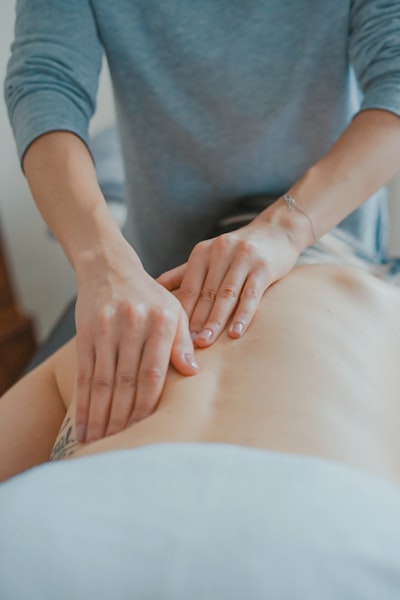
By the time I was thirteen, something had shifted. I started offering massage to neighbors and relatives in Jerusalem, not because anyone asked me to, not because I'd read a book about it, but because I felt called to try. Someone would mention a sore back, a stiff neck, a persistent ache, and I'd ask: can I try something?
The responses surprised even me. People would tell me it hurt, in that particular way that means it's working, that something stuck is starting to move, and then they'd tell everyone they knew. Word spread the way it always does when something genuinely helps: quietly, person to person, with a kind of quiet certainty. You have to go to this kid. He has something.
I didn't fully understand what I had. I just kept practicing.
From Instinct to Knowledge
At nineteen I enrolled at the Wingate Institute in Israel, one of the country's most respected sports and health institutions, and began my formal training in massage therapy. It was a pivotal experience, but perhaps not in the way you'd expect.
What formal training gave me wasn't the ability to feel, I already had that. What it gave me was language. Structure. A framework for understanding what my hands had been doing intuitively for years. Suddenly there were names for things I'd always sensed: fascial tension, trigger points, referred pain patterns, the relationship between the nervous system and muscular holding.
The knowledge didn't replace the intuition. It deepened it.
Later, when I came to the United States, I continued studying, earning formal training and certification in New York, and traveling to Washington State to explore additional modalities. Deep tissue. Shiatsu. Lomi Lomi. Swedish. Sports massage. Each one added a new dimension to how I understood the body and what it needed.
Of all the modalities I've studied, Lomi Lomi, the ancient Hawaiian healing practice, left a particular impression. Its extraordinary flow, its dense and enveloping quality, the way it treats the body as a whole rather than a collection of parts. I carry its spirit into almost every session I do, even when I'm not technically practicing it.
Why I Never Do Just One Type of Massage
People sometimes ask me: what kind of massage do you do? And my honest answer is: the kind your body needs today.
After decades of practice, I've come to believe that rigid adherence to a single modality is a limitation, not a credential. Every body is different. Every session is different. The person who comes in on Tuesday after a stressful week needs something entirely different from the same person who comes in on Friday after a good one.
What I bring to each session is a combination of deep technical knowledge across multiple modalities, a highly developed tactile intuition built over twenty-plus years, and the willingness to follow what I feel rather than what a protocol says I should do.
I modify. I adapt. I listen, with my hands as much as with my ears. And I never stop asking: what does this particular body, in this particular moment, actually need?
The Face That Changes Everything
Twenty years in, there's still one thing that never loses its power: watching someone's face change.
People come in holding so much. You can see it before they say a word, in the set of their jaw, the tension around their eyes, the way they carry their shoulders like armor. And then, as the session progresses, something shifts. The armor softens. The jaw unclenches. The breath deepens and slows.
Some people get quiet and still. Some drift into a half-sleep state, that beautiful, woozy space between here and somewhere else, where the nervous system finally lets go of its vigil. Some people feel things they haven't felt in years. Some cry, gently, without knowing exactly why. Some open their eyes at the end looking slightly stunned, as if they've forgotten what it felt like to be this relaxed in their own body.
That face, that transformation, is why I do this work. Not the technique. Not the modality. That face.
A Practice Built Across Continents
My path has been a long and rich one. From Jerusalem to New York, where I established and ran three spas and built a practice that drew clients from every walk of life, executives, artists, politicians, performers. Names I will never share, because discretion and trust are the foundation of this work. But the experiences shaped me profoundly.
From New York to Florida. From Florida to Washington State, where I deepened my study of additional modalities. Back to Israel for a period. And now, here, Austin, TX.
Each city, each practice, each client added something. Not just technique, perspective. An understanding of what people from very different backgrounds, pressures, and lifestyles carry in their bodies. How stress manifests differently in different people. How healing looks different for a performer on tour than for an executive under deadline than for someone simply trying to reconnect with themselves after years of neglect.
Sagi Wellness is not my first practice. It is my most intentional one. Everything I've learned, across twenty years, multiple countries, thousands of sessions, is distilled into this single space, designed to offer one person at a time the full depth of what I know.
I work with one client at a time. By design. Because that's the only way I know how to do this work properly.
I can't wait to meet you.
. Sagi